
"Serious" Stool
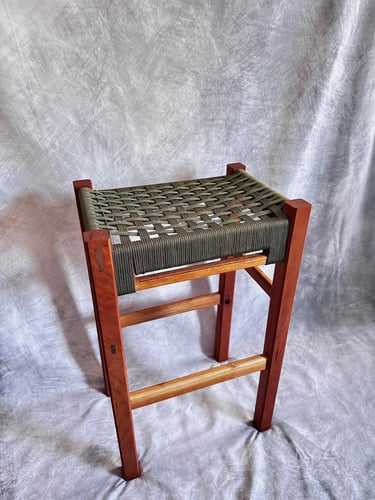
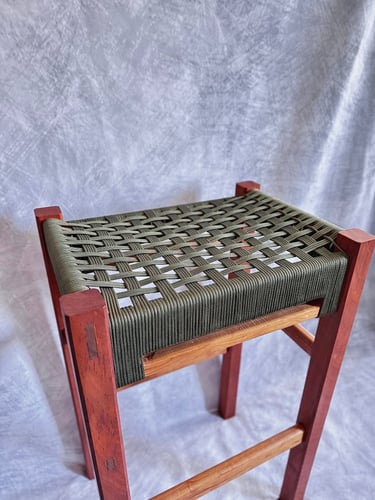
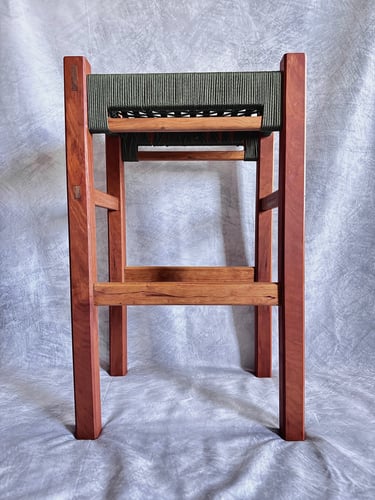
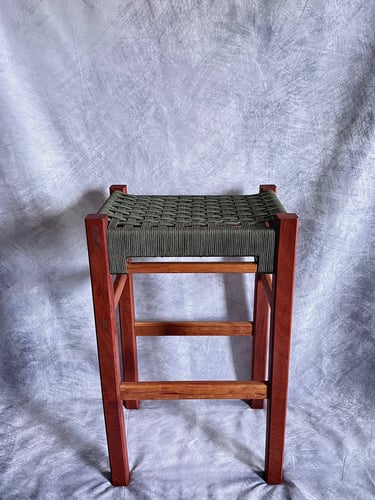
Every maker has a piece that marks a before and after. For me, it's this stool. At the time, a Danish-style stool felt like a serious undertaking, and it was. The design lived in my head for a while before I felt ready to commit it to wood, and the build itself was a steady exercise in patience and developing technique. The joinery is mortise and tenon throughout, and working through it methodically was one of those experiences where you can feel your skills consolidating in real time.
The seat is woven in paracord; the same material engineered for parachutes, which means it is, by any reasonable measure, overqualified for sitting on. I chose an olive green, drawn as I am to earthy tones, and the color grounds the piece in a way that feels natural alongside the wood.
One considered departure from convention was the use of hide glue in place of standard woodworking adhesive. Hide glue is reversible; it allows joints to be carefully disassembled and repaired without damaging the surrounding wood. It's a detail most people will never know is there, but it matters to me. Furniture built to last generations should also be built to be cared for across them. Should a grandchild, in some distant future, test the structural limits of this stool in the way that grandchildren tend to, the repair will be straightforward.
A small confession: I set out to build a counter stool. The measurements I cut produced a bar stool. I built the bar stool, and I have made my peace with it. This piece will not leave my home. Not because it's precious, but because it's the reason my first commission found me; and that kind of origin deserves a permanent place.
Altar
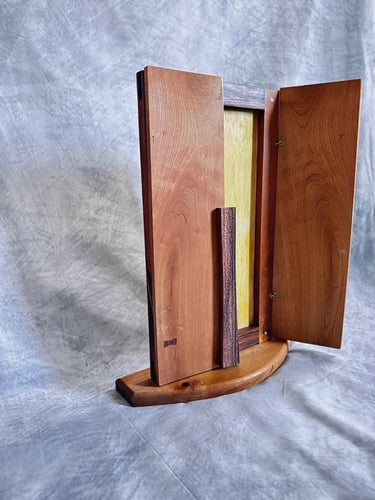
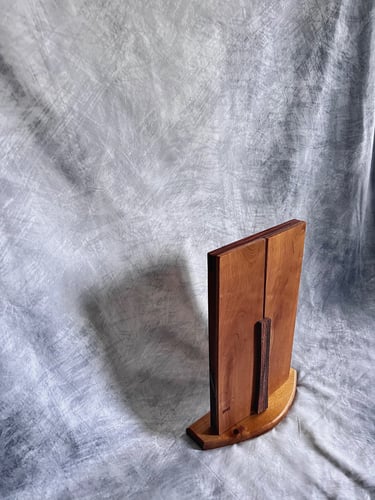
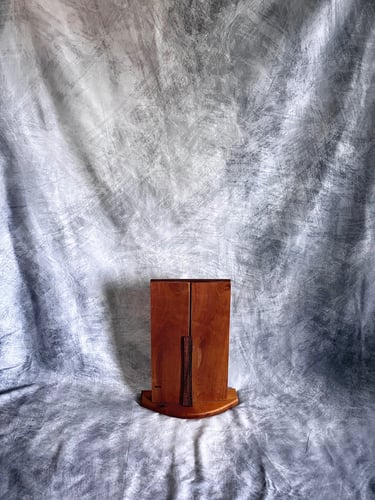
There are objects we make for the world, and objects we make for quieter, more personal reasons. This altar was the latter. Built from cherry and rosewood, the piece gave me an opportunity to work with bridle joints — reinforced here with brass dowels, which added a subtle structural and visual detail that felt appropriate for something meant to be both functional and contemplative.
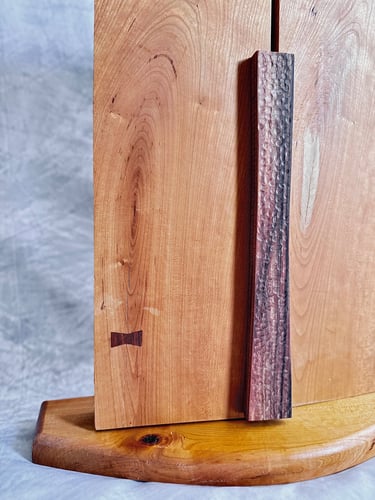
The doors presented an early challenge. Bookmatching the cherry sides revealed a crack in one panel; the kind of discovery that tests the zero-waste principle I hold closely. Rather than setting the piece aside, I worked the crack into the design with a bowtie inlay. It's a technique I find somewhat overused in the craft, but in this case it earned its place: a practical solution that became a quiet design detail.
The hidden hinges, while the right choice aesthetically, required patience to install at that scale. The hardware was small, the tolerances unforgiving, and I'll admit there were moments when a set of standard hinges felt like a reasonable compromise. They weren't, and I stayed the course. The door pull is a custom carved piece with hand-scalloped detailing along the top; one of those small decisions that, when it comes together, makes the whole piece feel resolved.
The base is connected to the cabinet body through dowel joinery, and I chose to shape it rather than leave it as a simple rectangle — a small but deliberate gesture toward proportion and refinement.
If I were to revisit the design, I'd give it a slightly deeper profile. My Gohonzon fits, but the piece could have been more generous in that dimension. A note for the next one.
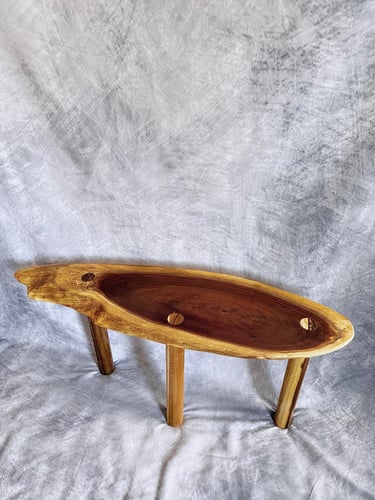
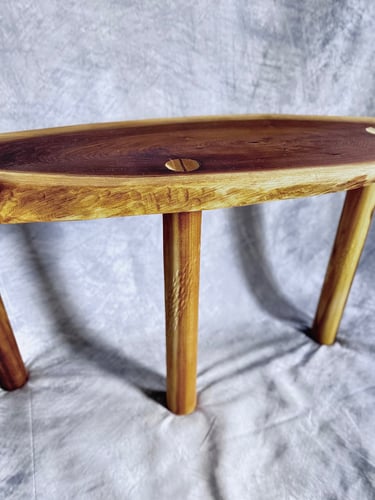
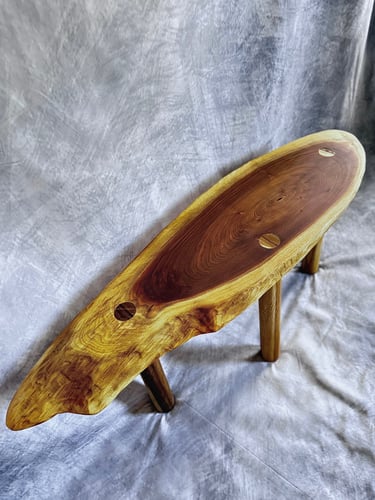
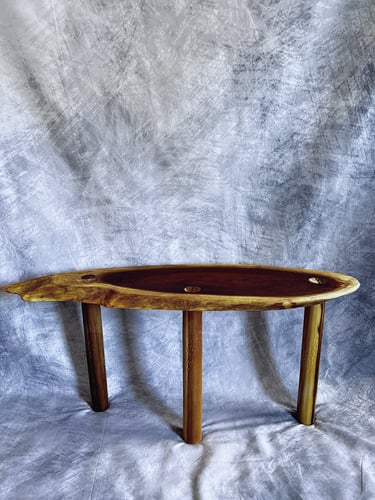
Those three legs
This walnut cookie came home with me from a NJ Wood Fest, picked up on instinct and stored in the shed for months. It wasn't until I returned from my Japanese joinery intensive in Portland that I knew what it wanted to become. The timing felt right, and so did the challenge.
The joinery decision was an interesting one in hindsight. Having just learned wedged mortise and tenon construction, I was keen to apply it — but the technique typically calls for square or rectangular tenons, and this piece had other ideas. Working with the natural form of the cookie meant adapting the process to accommodate a round tenon instead. It required some improvisation, but that problem-solving is often where the most useful learning happens.
For the legs, I wanted to preserve a sense of the wood's natural character. The hand-carved details were a way of referencing the tree itself — treating the legs less as structural components and more as an extension of what the material already was. The irregular shape of the cookie also made the case for three legs rather than four, which was a considered risk in both design and balance. It holds up fine in most scenarios. Structurally and aesthetically.
Custom Build / Shower Shelving
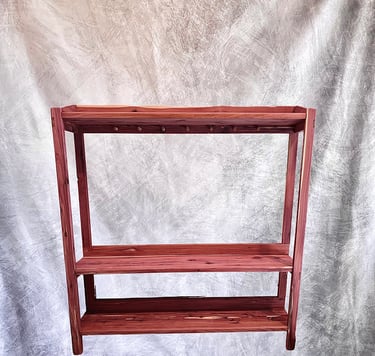
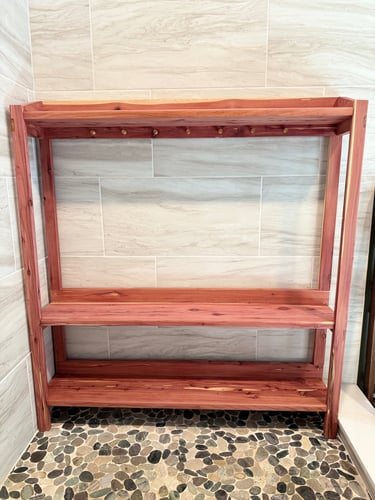
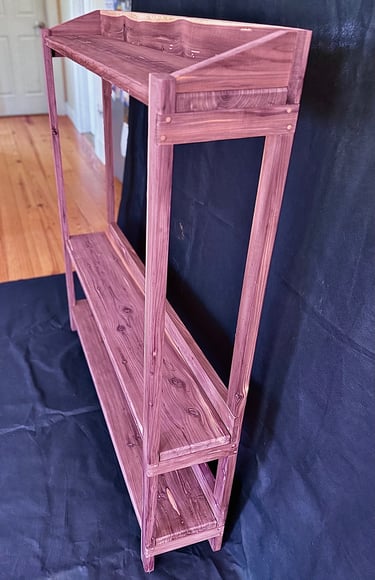
The shed smelled extraordinary for weeks. That alone felt like a reasonable measure of success. This shelving system was built entirely from Eastern red cedar — a commission with a clear brief: functional storage that brings its natural fragrance into the space. Cedar has a way of making that request easy to fulfill. It does the work on its own.
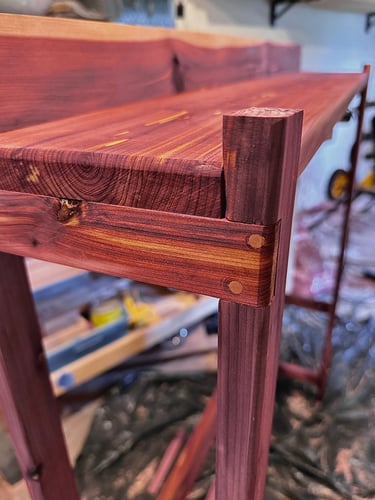
The joinery is half-lap throughout, reinforced with wooden dowels for both structural integrity and visual interest. Given that the piece would live in a humid environment, I used Titebond III; a waterproof adhesive that holds its bond where standard glue would eventually concede to moisture. A practical choice that disappears into the build, as the best practical choices tend to do.
The knots were left in deliberately. Cedar's knots are characterful rather than flawed, and removing or filling them would have meant working against the wood rather than with it. They give the piece an honesty that felt right for the material. The shelves are modular and fully removable — a considered detail that allows the wood to move naturally with seasonal temperature and humidity shifts. Wood that can breathe tends to last considerably longer than wood that can't. The finish is a blend of cedar oil and Howard's conditioning wax, applied to protect without obscuring. It keeps the grain present and the fragrance very much alive.
Three weeks in total — two to build, one to finish. Some of the best-smelling three weeks the shed has seen.
The Beast
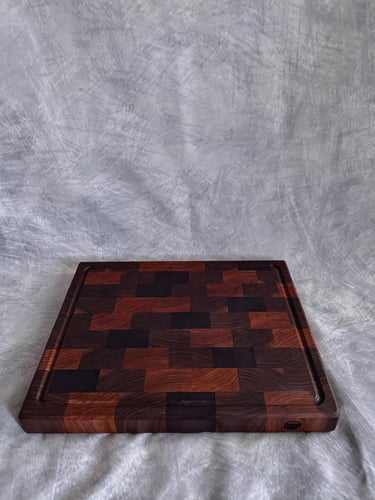
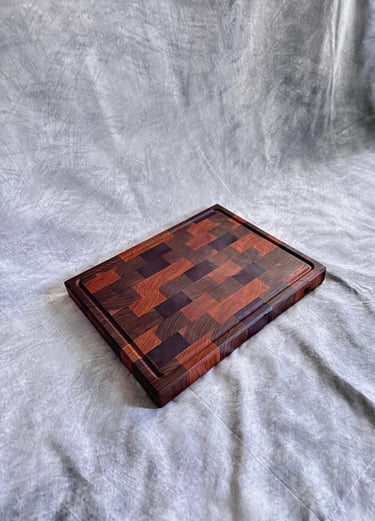
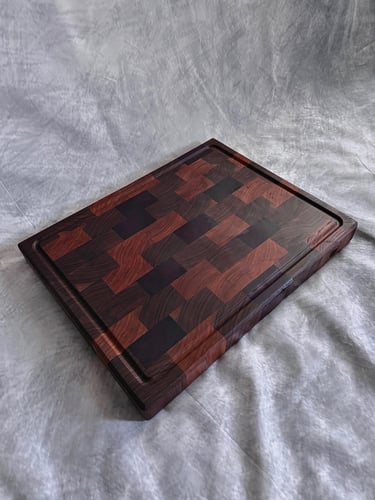
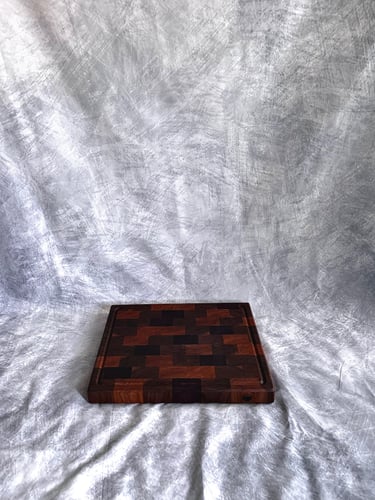
This one's a beast — 5 lbs of cherry, walnut, and Purple Heart, and honestly the grain on this piece stopped me in my tracks when it came out of the shop.
End grain boards are one of those things I never get tired of making, but I won't sugarcoat it — they're a pain. Any woodworker will back me up on that. After making more of these than I can count, they're still the most unforgiving thing I build. Sloppy milling, uneven moisture content — it shows up in the joints fast, and there's nowhere to hide.
That's actually what keeps me coming back to them. Every board has its own thing going on — the pattern is never planned, it just reveals itself, and when it lands right, it's one of the most satisfying things you can pull out of the shop.
Quality end grain boards are genuinely rare. Now you know why.